Версия для слабовидящих

Размер текста:

Цветовая схема:

Изображения:

Conference overview 

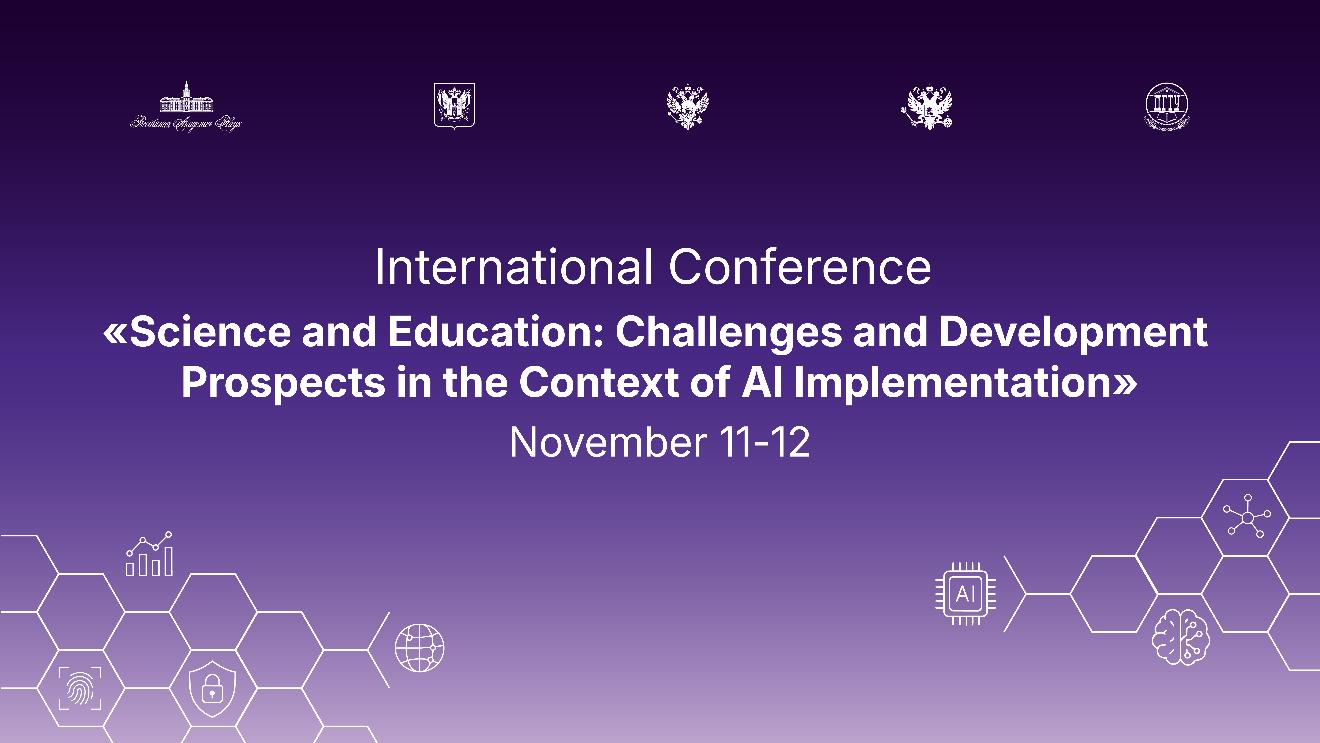
The conference «Science and Education: Challenges and Development Prospects in the Context of AI Technology Implementation» is an international expert and analytical platform that brings together leading scientists, university leaders, representatives of government bodies, developers of educational technologies, specialists in the field of artificial intelligence, and education practitioners. The focus is on understanding how AI technologies are changing the very architecture of the educational process, scientific research, and academic communication, as well as what new opportunities and risks arise in this regard.

The conference will feature presentations, discussion sessions, panel discussions, and master classes dedicated to the AI-based personalization of learning, adaptive educational trajectories, intelligent decision support systems, the automation of learning outcome assessment processes, issues of academic integrity in the context of generative models, as well as the ethics and security of using AI in science and education. Special attention will be paid to the experience of universities that have already implemented AI solutions in the educational process and research, as well as to cases of AI‑driven reconfiguration of scientific domains and the introduction of AI laboratories as the core of the university’s scientific transformation.

The conference is designed to be interdisciplinary, encompassing fields such as pedagogy, educational administration, computer science, sociology, philosophy, law, and economics. A significant aspect of the program will involve the exploration of AI literacy as a new essential competency for all stakeholders in the educational process, alongside the formulation of recommendations for constructing a regulatory, methodological, and infrastructural framework to ensure the sustainable integration of AI in university settings. The conference outcomes are anticipated to include the publication of materials, analytical documents, and practical guidelines.

The goal of the conference is to create a unified expert envirounment for discussing systemic challenges and strategic prospects for the development of science and higher education in the context of large‑scale implementation of artificial intelligence technologies, as well as to develop practical recommendations for transforming educational models, research practices, and management decisions in the era of AI.
About the conference

Register
About the conference

Conference languages

  • Russian
  • English 

Venue

Rostov-on-Don, 1 Gagarin Square, Don State Technical University

(hybrid format: in-person and online event)

Publication of Conference Proceedings

A special issue of the journal «Innovative Science: Psychology. Pedagogy. Special Education» is planned based on the conference results. Peer-reviewed articles will be published free of charge. Please submit materials for review to the email address

spu-10.2@donstu.ru by November 20, 2026.

Conference objectives

To analyze the key challenges that the introduction of AI creates for traditional models of education, scientific activity, academic ethics, and knowledge assessment.

To discuss current trends in the use of AI in the educational process, research work, quality management of the educational process, and in the overall development of educational ecosystems.

Consider the issues of developing AI capabilities among students, teachers, and researchers, including digital literacy, critical thinking, and an ethical culture for working with algorithmic systems..

Determine the most effective approaches to incorporating AI instruments into educational curricula, academic initiatives, and university partnership networks.

Develop recommendations for educational authorities, higher education institutions, and research entities to establish a secure, transparent, and efficient framework for AI utilization.

Target groups

Representatives of education and science policy management bodies at the federal and regional levels.

Strategic and scientific leaders, heads of universities and research institutes.

Teachers, researchers, methodologists, and specialists in digital education.

Practitioners and researchers in the field of educational technologies and the application of AI in science and education.

Developers of educational technologies, AI platforms, and digital solutions for science and education.

Graduate students, doctoral candidates, young scientists, and students interested in issues related to AI application in education and science.

Program Committee Chairs

#

Meskhi B.Ch.

Rector of Don State Technical University, Doctor of Technical Sciences, Professor, Academician of the RAE, Member of the Georgian National Academy of Sciences, Member of the Central Council of the All-Russian Society of Inventors and Innovators

#

Vasilyeva O.Yu.

President of the Russian Academy of Education, Doctor of Historical Sciences, Professor

#

Basyuk V.S.

Vice President of the Russian Academy of Education, Doctor of Psychology, Associate Professor

#

Mladen Vilotijević

President of the Serbian Academy of Education, Academician, Professor

Deputy Chairs of the Program Committee

#

Beskopilny A.N.

Vice-Rector for Academic and International Affairs, Don State Technical University, Doctor of Engineering Sciences, Professor

#

Lazar Stošić

President of the Association for the Development of Science, Technology, and Education (Serbia), Dean of the Faculty of Informatics and Computer Science, Nikola Tesla University Union (Belgrade, Serbia), Professor

Program committee members

#

Ermakov P.N.

Academician of the Russian Academy of Education, Doctor of Biological Sciences, Professor, Head of the Southern Scientific Center of the Russian Academy of Education, First Vice-President of the Russian Postgraduate Education

#

Abakumova I.V.

Academician of the Russian Academy of Education, Doctor of Psychology, Professor, Head of the Department of General and Counseling Psychology, Dean of the Faculty of Psychology, Pedagogy, and Defectology, Don State Technical University

#

Sukhinov A.I.

Corresponding Member of the Russian Academy of Sciences, Doctor of Physical and Mathematical Sciences, Professor, Head of the Department of Mathematics and Computer Science at DSTU

#

Uvarovsky A.P.

Candidate of Pedagogical Sciences, Professor of the Russian Academy of Natural Sciences, Associate Professor, Director of the Autonomous Non-Profit Organization Center for Independent Education Quality Assessment and Educational Audit "Legion"

#

Murugova E.V.

Doctor of Philology, Professor, Dean of the Faculty of Applied Linguistics at DSTU

#

Abraukhova V.V.

Doctor of Pedagogical Sciences, Associate Professor, Head of the Department of Engineering Pedagogy and Vocational Education at DSTU

#

Fedotova O.D.

Doctor of Pedagogical Sciences, Professor, Head of the Department of Education and Pedagogical Sciences at DSTU

#

Godunov M.V.

Doctor of Pedagogical Sciences, Associate Professor, Head of the Department of Personality Psychology and Psychodiagnostics at DSTU

#

Belousova A.K.

Doctor of Pedagogical Sciences, Professor, Head of the Department of Educational Psychology and Organizational Psychology at DSTU

Key topics and questions

Section 1. Open Science 2.0: methodologies and tools of AI in research processes

Section 1. Open Science 2.0: methodologies and tools of AI in research processes

Section leader – Sukhinov A.I

  • Best practices and case studies of implementing cognitive systems and AI in fundamental and applied research
  • Issues related to the validation of AI models, ensuring the reproducibility of results, and managing scientific data
  • The impact of AI on scientific communication and publication practices
  • Interdisciplinary research using AI: from data processing to advanced knowledge and technologies

Section 2. The influence of AI on higher education models: new learning formats, effectiveness assessment, transformation of social processes.

Section 2. The influence of AI on higher education models: new learning formats, effectiveness assessment, transformation of social processes.

Section leader –  Abakumova I.V.

Section co-leaders – Godunov M.V., Belousova A.K.

  • The architecture of a new educational paradigm: hybrid environments, adaptive and micro‑learning, AI assistants in higher education.
  • Regulatory and legal aspects of using AI in education.
  • Methodologies for assessing the effectiveness of AI‑driven transformation of educational programs and institutions.
  • Digital inequality and inclusion: sociocultural challenges, changes in social connections, and the risks of robotization in higher education.

Section 3. The transformation of academic staff in the era of AI

Section 3. The transformation of academic staff in the era of AI

Section leader – Abraukhova V.V.

Section co-leader – Fedotova O.D.

  • New professional roles and competencies of teachers in the context of the «cognitive complementarity» of the educational environment.
  • Transformation of academic ethics and knowledge assessment methodology in the era of generative networks.
  • Psychological adaptation and readiness of academic staff to work in an AI‑rich environment.
  • Strategies for the development of pedagogical education and retraining of existing scientific and teaching staff.

Section 4 Multilingual education in the context of AI technology implementation

Section 4 Multilingual education in the context of AI technology implementation

Section leader – Murugova E.V.

  • Innovative pedagogical approaches based on AI tools in multilingual education
  • Multimodality in a multilingual environment: communication, pragmatics, and anthropological aspects in the era of AI
  • Legal and regulatory frameworks for multilingual education, challenges, approaches, and best practices
  • Key indicators of the effectiveness of multilingual educational programs and quality assurance in multilingual education.

Conference venue

DSTU Congress Hall

spu-10.2@ donstu.ru Rostov-on-Don, Gagarin Square, 1, DSTU Congress Hall